
In the dynamic, often strenuous world of modern asana practice, where value is frequently measured by the depth of a backbend or the steadiness of a handstand, there exists a pose that defies all conventional metrics of achievement.
It requires no flexibility, demands no strength, and offers no visually impressive shape. It is, in fact, the pose of doing nothing at all. This is Savasana, or Corpse Pose, and it is, paradoxically, the most challenging and most important posture in the entire yogic canon.
To the uninitiated, Savasana appears to be a simple act of lying down. It is often mistaken for a well-deserved nap at the end of a class, a chance to check the clock, or mentally compile a grocery list.
This misunderstanding represents the greatest hurdle to accessing its transformative potential. Savasana is not passive rest; it is active surrender. It is a conscious, wakeful state of profound relaxation where the body is completely still, the senses are withdrawn, and the mind is invited to witness without attachment.
It is the laboratory where the benefits of the physical practice are alchemized and integrated into the very fabric of our being. This article will explore the profound depth of Corpse Pose, illuminating its physiological necessity, its psychological challenges, and its ultimate purpose as the culminating state of yoga itself.
The Physiology of Letting Go: Why Savasana is Not Optional
The physical postures of yoga are designed to create a state of controlled, beneficial stress. They elevate the heart rate, stimulate the nervous system, and create micro-tears in muscle fibers.
This is the «stress» part of the workout, essential for growth. Savasana is the essential «rest» that allows for adaptation and integration.
- Nervous System Recalibration: A vigorous yoga practice primarily engages the sympathetic nervous system (SNS), our «fight-or-flight» response. While this is healthy in controlled doses, living in a chronic state of SNS dominance is a hallmark of modern stress. Savasana is the direct dial to the parasympathetic nervous system (PNS), the «rest-and-digest» state. When we lie still in Savasana, the body receives the unambiguous signal that the emergency is over. The heart rate slows, blood pressure decreases, and the body shifts its resources from external performance to internal repair and regeneration. Skipping Savasana is like driving a car at high speed and turning off the engine without idling—it’s jarring and prevents the systems from cooling down properly.
- Muscular and Hormonal Integration: During the physical practice, the body releases hormones like cortisol and adrenaline and sends blood to the working muscles. In Savasana, this process reverses. The body begins to repair muscle tissue, a process that requires a calm state. The endocrine system rebalances, and the brain releases feel-good hormones like endorphins and oxytocin. This is where the physical strength and flexibility you’ve cultivated are literally «downloaded» into your system. Without this phase, the benefits of the practice are significantly diminished.
- The Homeostatic Reset: The body has an innate intelligence, a drive toward homeostasis, or balance. The heat generated in practice is balanced by the cool stillness of the floor. The effort of contraction is balanced by the profound release of letting go. The mental focus required for balancing poses is balanced by the open awareness of Savasana. This pose is the essential counterpose to everything that came before it, the yin to the practice’s yang. It completes the cycle, allowing the body and mind to return to a new, more integrated state of equilibrium.
The Architecture of Surrender: The Precise Alignment of Non-Doing
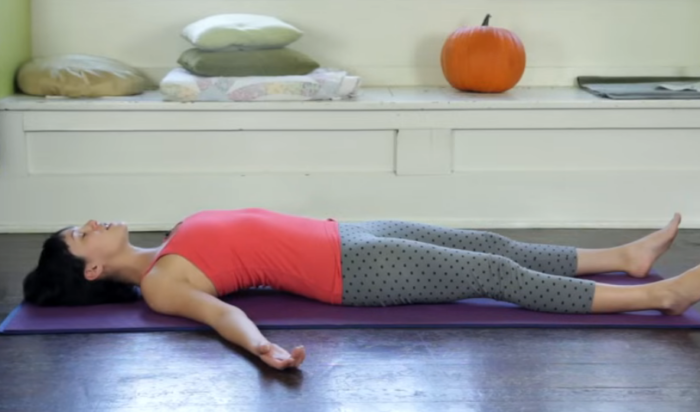
While it looks simple, a conscious Savasana has a specific, intentional setup. The alignment is not about creating a shape, but about creating the conditions for the nervous system to fully let go.
- The Foundation: Lie flat on your back on a firm but comfortable surface. Use a yoga mat for insulation from the cold floor.
- The Legs: Allow your legs to extend long, with your feet falling naturally out to the sides, about hip-width apart. This position releases tension in the hip rotators and lower back.
- The Arms: Rest your arms alongside your body, but slightly away from your torso, with the palms facing up. This is a gesture of receptivity, opening the chest and the heart center (Anahata Chakra). Ensure your shoulders are relaxed down and away from your ears.
- The Head and Spine: Gently tuck the chin slightly toward the chest to create a long, neutral cervical spine. It can be helpful to have a teacher gently cradle your head and lift it slightly to ensure the neck is long before releasing it back down.
- The Senses: This is the most crucial internal action. Close your eyes. Begin to consciously withdraw your awareness from the external world. This is the practice of Pratyahara, the fifth limb of yoga. Notice sounds, but don’t label them or follow them. Feel the air on your skin, but don’t react to it. Let the world be as it is, without you needing to engage with it.

The Psychological Battlefield: Confronting the Resistance
This is where Savasana reveals its true difficulty. The body may be still, but the mind often becomes a riot of activity. This is not a sign of failure; it is the very material of the practice.
- The Itch, The Twitch, The To-Do List: It is inevitable. An itch will arise on your nose. You will feel a compelling need to adjust your shirt, to fidget, to swallow. A thought about a work email will surface, followed by a mental replay of a conversation. This is the mind’s resistance to stillness, its addiction to «doing.» The practice of Savasana is to witness these impulses without obeying them. Observe the itch with curiosity—where is it? What does it feel like?—and more often than not, it will dissolve on its own. See the thought as a cloud passing through the sky of your awareness, without latching onto it.
- The Discomfort with Stillness: In a culture that glorifies busyness, true stillness can feel alien, lazy, or even frightening. It forces us to be alone with ourselves, without distraction. We may encounter underlying anxiety, sadness, or boredom that we normally keep at bay with constant activity. Savasana is a brave practice of sitting with whatever arises, of learning that we can be still and safe at the same time.
- The Illusion of Control: By forcing us to be utterly receptive and passive, Savasana directly challenges our ego’s need for control. We cannot make ourselves relax. We can only create the conditions for relaxation and then surrender to the process. This is a profound spiritual lesson: that true peace comes not from controlling our experience, but from letting go of the need to control it.
The Ultimate Goal: A State of Yoga
Patanjali’s Yoga Sutras define yoga as «Yogas chitta vritti nirodha»—the cessation of the fluctuations of the mind-stuff. This is not a state that can be achieved while actively balancing or stretching. It is in the profound, conscious stillness of Savasana that we have the best opportunity to experience this state directly.
When the body is completely at ease and the senses are withdrawn, the mental chatter (vrittis) begins to slow down. The space between thoughts widens. In those gaps, we may catch a glimpse of the silent, aware consciousness that is our true nature—the witness that is untouched by the body’s sensations or the mind’s dramas.
This is not a philosophical concept to be understood, but a state to be experienced. Savasana is the practice ground for this experience. It is the asana that most directly leads to the state of meditation (Dhyana) and, ultimately, absorption (Samadhi).
A Guide to a Deeper Savasana
Moving beyond just lying down requires intention. Here is a simple guide to a more integrated practice:
- Systematic Relaxation: Starting from the tips of your toes, consciously send a message of release to every part of your body. Move slowly upward: relax the feet, the ankles, the calves, the knees, the thighs. Surrender the hips, the pelvis, the entire abdomen. Let go of the lower back, the upper back, the chest. Release the fingers, the hands, the wrists, the arms, and the shoulders. Soften the throat, the jaw, the tongue, the muscles around the eyes, and the space between your eyebrows.
- Breath Awareness: After relaxing the body, bring your awareness to your natural breath. Don’t try to change it. Simply observe the sensation of the inhale and the exhale. Feel the slight pause between them. Let the breath be a gentle anchor, bringing you back when the mind wanders.
- The Return: When it’s time to come out, do so with the same mindfulness you cultivated. Avoid jerky movements. Slowly begin to deepen your breath. Gently wiggle your fingers and toes. Draw your knees into your chest and roll onto your right side into a fetal position, taking a moment to integrate. Use your hands to press yourself up to a seated position, carrying the stillness of Savasana with you.

The Final Integration
Corpse Pose, Savasana, is the ultimate teacher of non-attachment. It is a rehearsal for the final surrender we will all one day make, allowing us to practice letting go of our body, our thoughts, and our identity with awareness and grace, rather than fear.
To honor Savasana is to understand the true purpose of yoga. The physical practice is the prelude; the stillness is the symphony. It is in the silent, wakeful nothingness of the Corpse Pose that the seeds of our practice bear fruit. It is where we digest not just our food, but our entire life experience. It is the space where we remember who we are beneath the roles, the achievements, and the striving.
It is not an add-on or a cool-down; it is the destination. So, the next time you come to your mat, practice the asanas with diligence and heart, but save your deepest reverence for the final pose. Lie down as if your life depends on it, for in the art of conscious surrender, you may just find that you are more truly alive than ever before.
This Other Extraordinary Publication «The Art of the Awakening: Crafting a Morning Yoga Routine to Transform Your Day» Might Interest You! Come in and check it out!!!
I hope you enjoyed this article emphasizing «Corpse Pose (Savasana): The Ultimate Practice of Conscious Surrender». You can share your thoughts and experiences with me in the comments section.