
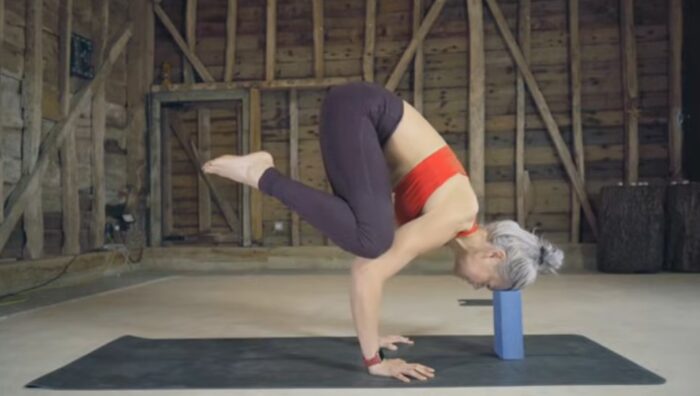
In the journey of a modern yogi, few moments are as electrifying and transformative as the first successful hover in Crow Pose. It is a rite of passage, a definitive before-and-after moment where you cross a threshold from being earth-bound to experiencing the exhilarating, if fleeting, defiance of gravity.
For many, Bakasana represents the first «advanced» pose they feel is within reach, yet it remains shrouded in a potent mix of desire and trepidation. The sight of a practitioner, poised on their arms, knees tucked high, body compact and focused, is a powerful image of strength, concentration, and lightness.
But Crow Pose is far more than a physical party trick. It is a master teacher, a pose that demands and cultivates a unique alchemy of physical strength, precise alignment, and, most importantly, mental fortitude. It is on the mat in Crow Pose that we often meet our fear of falling head-on, and in learning to navigate that fear, we unlock not just the ability to balance on our hands, but a deeper confidence that permeates our life off the mat.
This article will serve as a comprehensive guide to Crow Pose, deconstructing its anatomy, illuminating the psychological hurdles, and providing a detailed, step-by-step pathway to finding your own first flight.
The Foundation of Flight: Deconstructing the Anatomy of Bakasana
To understand how to achieve Crow Pose, one must first understand what it requires from the body. It is a common misconception that Crow is all about arm strength. While strong arms are beneficial, the true secret to a light, sustainable Crow lies in the core and the alignment of the entire body.
- The Upper Body: A Stable Scaffolding
The arms and shoulders act as the foundational scaffolding for the pose. They must be active and engaged, not passive supports.
- Shoulders: The shoulders need to be protracting—that is, actively rounding forward and away from the ears. This creates a shelf with your upper back. A common error is to let the shoulders sink toward the ears or the shoulder blades to pinch together, which collapses the foundation.
- Arms and Elbows: The arms are bent, with the elbows stacking directly over the wrists. This is a critical alignment point. If the elbows drift wide, you lose stability; if they drift behind the wrists, you risk pitching forward. The hands are planted firmly, fingers spread wide like starfish, pressing down through all knuckles to engage the forearm muscles.
- The «Shelf»: The combination of rounded upper back and bent arms creates a stable, inclined platform—the «shelf»—upon which the knees will eventually rest.
- The Core: The Engine of Elevation
This is the true powerhouse of Crow Pose. The core is not just the abdominals; it is the entire central cylinder of the body, including the deep transverse abdominis and the obliques.
- Engagement: The core must be engaged to lift the hips high and to draw the knees in toward the chest. This engagement is what actually lifts the feet off the floor. The action is one of a deep abdominal hollowing and a rounding of the entire spine (spinal flexion), which helps to bring the center of gravity over the hands.
- The Role of the Pelvis: The pelvis tilts posteriorly (think of tucking your tailbone), which further facilitates the rounding of the spine and helps to pack the body into a compact, liftable bundle.
- The Lower Body: Compact and Light
The legs are not dead weight; they are active participants.
- Knees: The knees rest high up on the back of the upper arms, as close to the armpits as possible. The wider the knees are placed on the arms, the less stable the pose will be.
- Feet: The feet are drawn in toward the buttocks. This action shortens the lever of the legs, making the entire structure lighter and easier to lift. It also ensures that when you do lift off, the feet are already elevated and won’t scrape the floor.
The Psychology of the Pose: Confronting the Fear of Falling
The primary obstacle in Crow Pose is rarely physical. It is the primal, deeply ingrained fear of falling forward onto one’s face. This fear triggers a cascade of physiological responses: the breath is held, the shoulders tense, the gaze becomes frantic. All of these reactions directly sabotage the very balance we are trying to achieve.
- The Safety Net: Reframing the Fall
The single most effective way to manage this fear is to remove its power. And the best way to do that is to practice falling.
- Place a Pillow: Put a soft pillow, a folded blanket, or a bolster directly in front of your mat. Intentionally lean too far forward and let yourself tumble onto it. Do this several times. You will quickly realize that the fall is soft, harmless, and over in a second. This simple act of «practicing failure» rewires the brain’s fear response. Falling is no longer an unknown catastrophe; it’s a manageable part of the learning process.
- The Gaze (Drishti): Your North Star
Your focus is your anchor. In Crow Pose, the Drishti is on the floor about a foot to a foot-and-a-half in front of your hands. Looking too far forward will cause you to pitch forward. Looking at your hands will cause you to lean back. A steady, soft gaze forward keeps the head in a neutral position and gives the brain a fixed point of reference, which is essential for balance. When the mind starts to panic, return to the Drishti. - The Breath: The Tether to Calm
Fear makes us hold our breath. Yoga teaches us to breathe through challenge. Maintaining a smooth, even Ujjayi breath throughout the attempt is crucial. The breath keeps the nervous system calm and the mind focused. An exhale can be used as a powerful tool to engage the core and find that final bit of lift.

The Pathway to Flight: A Step-by-Step Progression
Achieving Crow Pose is a process of building blocks. Rushing will only reinforce bad habits and frustration.
Step 1: Build the Prerequisite Strength
A little targeted strength work outside of your yoga practice can make a world of difference.
- Core: Practice Boat Pose (Navasana), hollow body holds, and leg lifts.
- Arms and Shoulders: Practice Chaturanga Dandasana and holding a low Plank Pose to build the necessary endurance in the arms, shoulders, and core.
Step 2: Master the Setup and Weight Shift
This is the most crucial part of the practice.
- Start in a Low Squat (Malasana): Feet as close together as comfortable.
- Plant Your Hands: Place your hands shoulder-width apart, about 8-10 inches in front of your feet. Press through the entire palm and spread your fingers.
- Create the Shelf: Bend your elbows, hug them in toward the midline, and round your upper back. Press your knees against the outside of your upper arms, as high up as possible.
- The «Magic» Lean: This is the moment of truth. Begin to shift your weight forward into your hands. Lift your hips high, higher than your shoulders. You will feel the feet become lighter. At this stage, keep the toes on the floor. Practice shifting forward and back, getting comfortable with the sensation of having most of your weight in your hands.
Step 3: The Lift-Off
From the setup in Step 2:
- Find Your Balance Point: Shift forward until you feel the weight evenly distributed in your hands. Your Drishti is forward.
- Engage the Core and Lift One Foot: With control, engage your deep core and lift one big toe off the floor. Hold it there. Then place it down and lift the other. This «teeter-totter» action builds the fine motor control needed for balance.
- The Final Lift: When you feel steady lifting one foot, try to draw the other foot in to meet it. The action is one of hugging the knees toward the arms and drawing the heels toward the buttocks, not of kicking up. It is a slow, controlled engagement of the core.
Step 4: Finding Refinement and Duration
Once you can hover, even for a second, the work becomes one of refinement.
- Hug the Midline: Continue to squeeze the knees against the arms and draw the elbows in toward each other.
- Round the Back: Actively press the upper back toward the ceiling.
- Breathe: Maintain your breath. The first time people hold Crow, they often realize they’ve been holding their breath and immediately come down. Breathe to stay.
Beyond the Crow: The Gateway Pose
Mastering Bakasana is not an end in itself; it is a key that unlocks the door to the vast and exciting world of arm balances. The strength, body awareness, and confidence gained from Crow are directly transferable to poses like:
- Side Crow (Parsva Bakasana)
- Crane Pose (a straight-arm version of Crow)
- Eight-Angle Pose (Astavakrasana)
- Firefly Pose (Tittibhasana)

The principles remain the same: create a stable foundation with the upper body, compact the core, and shift the center of gravity.
The Lesson in the Levitation
Crow Pose, Bakasana, is a profound teacher. On the surface, it is a lesson in anatomy and physics. But at its core, it is a practice in courage and trust. It teaches us that we are stronger than we think, that our bodies are capable of incredible things when our mind gets out of the way, and that the fear of failure is often far worse than failure itself.
The moment of lift-off is more than just getting your feet off the ground. It is a moment of profound self-belief. It is the physical manifestation of overcoming a mental obstacle.
Each time you find that balance, you are not just holding a yoga pose; you are reinforcing a neural pathway of courage, focus, and capability. You are learning to fly, first on the mat, and then, in countless small ways, in the world beyond it. So, place a pillow in front of you, set your gaze, trust your strength, and lean into the fear. Your first flight awaits.
This Other Extraordinary Publication «Downward Facing Dog (Adho Mukha Svanasana): Deconstructing the Heartbeat of Modern Yoga» Might Interest You! Come in and check it out!!!
I hope you enjoyed this article emphasizing «Crow Pose (Bakasana): Conquering Fear and Unlocking the World of Arm Balances». You can share your thoughts and experiences with me in the comments section.