
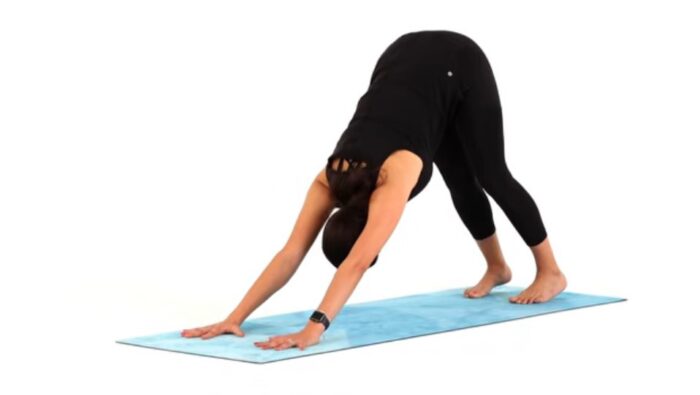
If modern yoga had a heartbeat, its rhythm would be the steady, flowing transition into and out of Downward Facing Dog. It is the veritable home base of a Vinyasa practice, a pose so ubiquitous that it has become almost synonymous with yoga itself. To the uninitiated, it appears as a simple inverted «V,» a basic stretch for the back of the body.
But to step onto the mat and truly meet Adho Mukha Svanasana is to engage with one of the most complex, multifaceted, and humbling postures in the entire yogic canon. It is a resting pose that demands work, a simple shape that reveals profound complexity, and a foundational posture that simultaneously builds strength, increases flexibility, and calms the nervous system.
Downward Facing Dog is a chameleon. It is a warm-up, a cool-down, a strength-builder, a rejuvenator, and a meditation all in one. It is the pose we return to again and again, a constant on the mat that serves as a mirror for our progress, our limitations, and our daily state of body and mind.
This article will embark on a deep exploration of this cornerstone pose, dissecting its anatomical intelligence, exploring its vast therapeutic benefits, and providing a detailed guide to refining its alignment, transforming it from a routine position into a masterclass in integrated, mindful movement.
More Than a Stretch: The Multifaceted Genius of Downward Dog
The genius of Downward Facing Dog lies in its unique ability to offer a full-body experience with a single shape. It is a dynamic combination of an inversion, a forward fold, and a weight-bearing exercise.
- A Global Stretch for the Posterior Chain
The most obvious benefit is the deep stretch it provides for the entire backside of the body, known as the posterior chain. This includes:
- The Calves and Hamstrings: For many, this is the primary sensation. The pose gently lengthens these often-tight muscle groups, which is crucial for overall leg health and pelvic alignment.
- The Spine: Downward Dog creates a gentle traction, decompressing the vertebrae and creating space between them. This can alleviate minor back aches and counteract the compressive effects of gravity and sedentary postures.
- The Shoulders and Armpits (Axilla): As the chest moves toward the thighs, the shoulders are stretched, and the latissimus dorsi muscles along the sides of the back are engaged and lengthened.
- A Foundational Strength-Builder
Despite its reputation as a «resting» pose, Downward Dog is a formidable strength-building exercise.
- Upper Body Engagement: The pose requires significant stabilization from the arms, shoulders, and upper back. The serratus anterior muscles, which wrap around the rib cage, are actively engaged to protract the scapulae (round the upper back), creating a stable shelf. This builds the foundational strength necessary for more advanced arm balances and inversions.
- Core Integration: To prevent the lower back from collapsing, the core must be actively engaged. The transverse abdominis draws in, and the obliques fire to maintain the integrity of the pose, making it an excellent isometric core exercise.
- A Gentle, Accessible Inversion
As an inversion, Downward Dog offers many of the benefits of more advanced poses like Headstand or Handstand, but in a more accessible and less intimidating format.
- Circulatory and Lymphatic Boost: Having the heart above the head reverses the flow of gravity, encouraging venous blood return from the legs and promoting lymphatic drainage. This can reduce swelling in the feet and ankles and create a feeling of refreshment.
- Nervous System Regulation: The pose has a calming effect on the nervous system. The combination of the inverted position and the focus on the breath can help to quiet the mind, reduce stress, and alleviate mild anxiety and fatigue.
The Blueprint of the Pose: Deconstructing Optimal Alignment
The journey to a refined Downward Dog is a lifelong practice. The ideal alignment is a balance of opposing actions, creating a sense of both grounding and elevation.
- The Foundation: Hands and Feet
Everything begins at the points of contact with the earth.
- The Hands: Place your hands shoulder-width apart. Spread your fingers wide, pressing down firmly through the knuckles of the index finger and thumb. This active hand engagement protects the wrists and distributes the weight evenly. Imagine you are suction-cupping your entire palm to the mat.
- The Feet: Position your feet hip-width apart. Press down through the ball of the foot, the base of the big toe, the base of the pinky toe, and the center of the heel. The toes can point straight forward or turn out slightly to accommodate tightness in the hips or lower back.
- The Journey Up the Body: Creating the «V»
- Arms and Shoulders: From the hands, energize up through the arms. Engage the triceps to keep the arms straight, but avoid locking the elbows. The key shoulder action is to externally rotate the upper arms—imagine twisting your inner elbows forward. Then, press the floor away from you, actively pushing your hips back. This creates the crucial «shelf» in the upper back and prevents the shoulders from collapsing into the ears.
- Spine and Ribs: The goal is to create a long, straight spine. Avoid rounding the upper back excessively or letting the lower back sag. The action is to draw the front ribs in and up, engaging the core to support the lumbar spine. Think of creating a long, neutral line from your wrists to your tailbone.
- Hips and Legs: The sacrum (the flat, triangular bone at the base of the spine) should be the highest point of the pose. To achieve this, engage your quadriceps (the front thigh muscles) to lift the kneecaps. This action helps to protect the knees and also supports the lift of the hips, deepening the stretch in the hamstrings.

The Refinement Process: Addressing Common Challenges
Every body is different, and Downward Dog will look and feel unique to each practitioner. The goal is not a perfect aesthetic, but a functional and sustainable alignment.
- If Your Heels Don’t Touch the Floor: This is one of the most common «struggles.» It is far more important to maintain a long spine with the hips high than to force the heels down with a rounded back. Solution: Keep a gentle bend in the knees. Focus on pushing the hips back and lengthening the spine. Over time, with consistent practice, the hamstrings and calves will release, and the heels will descend naturally.
- If You Feel Too Much Weight in Your Hands/Wrists: This indicates that the weight is not distributed evenly through the body. Solution: Consciously press your thighs back, engaging the legs more. Bend your knees deeply and focus on lifting your sit bones high to the ceiling. This shifts the center of gravity back toward the legs.
- If You Feel a Pinching in the Shoulders: This often means the shoulders are shrugging up toward the ears. Solution: Actively press the floor away. Create space between your ears and shoulders. Engage the muscles of your upper back to draw the shoulder blades down your back and widen them across your torso.
The Transformative Applications: Downward Dog as a Therapeutic Tool
Beyond the flow, Downward Dog is a powerful therapeutic tool.
- For Runners and Athletes: It is an excellent post-workout pose to stretch tight hamstrings, calves, and the plantar fascia, helping to prevent injuries like shin splints and plantar fasciitis.
- For Desk Workers: It counteracts the forward, hunched posture of sitting by opening the chest, stretching the shoulders, and decompressing the spine.
- For Stress and Anxiety: The combination of inversion, breath focus, and rhythmic movement makes it a potent practice for down-regulating the nervous system. Holding the pose for 10-15 deep breaths can serve as a moving meditation.
The Evolution of a Pose: A Lifelong Practice
The beauty of Downward Facing Dog is that it is never mastered; it is only explored. On a stiff day, it is a deep, intense stretch that reveals every tight spot. On a fluid day, it is a buoyant, energizing refuge. It is a pose that grows with you.
The beginner focuses on not collapsing. The intermediate practitioner refines the alignment of their shoulders and spine. The advanced practitioner finds subtle nuances of rotation and engagement, or uses it as a transition into more complex asanas.
It is the pose we are encouraged to «take a few breaths in,» offering a moment to check in with ourselves, to feel the body, and to steady the mind before moving on. It is the constant, the anchor, the heartbeat.
Returning Home to the Dog
Downward Facing Dog, Adho Mukha Svanasana, is the humble king of the modern yoga practice. It requires no special equipment, no prior acrobatic skill, yet it offers a depth of benefit that belies its simple form.

It is a pose of integration, teaching us how the strength of the arms supports the flexibility of the spine, how the engagement of the legs frees the shoulders, and how the focus of the mind can steady the entire structure.
To practice Downward Dog with awareness is to engage in a conversation with your own body. It is to learn the language of your hamstrings, the dialogue of your shoulders, and the quiet wisdom of your breath. It is a pose that builds not just physical resilience, but also patience, self-awareness, and a humble acceptance of where we are today.
So, the next time you flow into this familiar shape, pause. Press actively into your hands, lift your hips high, and breathe. Remember that you are not just holding a stretch; you are participating in a foundational ritual of strength, serenity, and self-discovery. You are, quite simply, coming home.
This Other Extraordinary Publication «Cobra Pose (Bhujangasana): Uncoiling the Spine, Opening the Heart, and Awakening Inner Vitality» Might Interest You! Come in and check it out!!!
I hope you enjoyed this article emphasizing «Downward Facing Dog (Adho Mukha Svanasana): Deconstructing the Heartbeat of Modern Yoga». You can share your thoughts and experiences with me in the comments section.